





Eye For Film >> Movies >> The Seoul Guardians (2026) Film Review

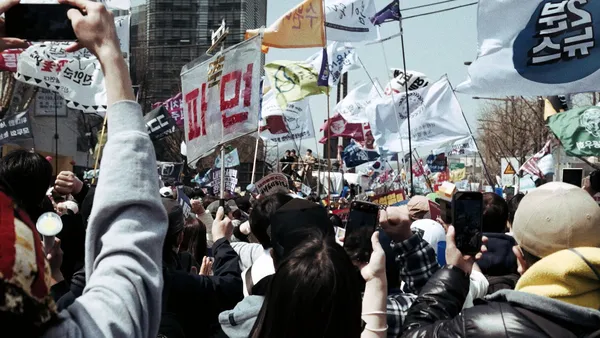

Whenever you watch world events unfolding on your TV screen, it’s worth keeping in mind that the people down there on the ground, the people actually shaping them, often have far less idea what’s actually going on than you do. Similarly, when you look back at events in history, you need to remember how different they felt to players with little awareness of how things would turn out. In the tradition of documentaries like Maidan and Everybody To Kenmure Street, The Seoul Guardians dives down into the crowd, using a patchwork of footage to reveal the events of the 3rd to the 4th of December 2024 in the South Korean capital from the perspective of those who were a part of it.
Directed by Cho Chul-young, Kim Jong-woo and Kim Shin-wan, and screened as part of the 2026 Fantasia International Film Festival, this is a film that will feel instantly familiar to those who have participated in such protests, and yet it’s obvious that many of those we are watching have not. Their ages, clothing styles and reaction to what they see around them tell us that they come from all walks of life, many as shocked as they are outraged by Yoon Suk Yeol’s precipitous declaration of martial law. Inside the National Assembly Proceeding Hall, the reaction is even stronger, as administrators, tourists and others who were imply going about their business find themselves caught in the middle of a terrifying situation.
Then there are the legislators themselves, both inside and outside the building. Outside, they struggle to get in, backed by the crowd, hindered by confused police officers who, with only a limited sense of their formal obligations, mostly cling to the orders their immediate bosses have given them. The word in the crowd is that not enough of them have made it to pass a motion undoing Yoon’s action. Older people who remember the events of 1961 plead with younger officers to understand what is at stake, certain that if democracy cannot be defended on this night then years will pass before they can win it back. Meanwhile, in the legislative chamber, all is quiet as formal proceedings take place, with nobody knowing if the vote will pass or, indeed, if it can be carried out in time.
Why ‘in time’? It’s not that there is a formal limit to the evening session. Rather, it is that the building is under siege. In the main hall, those tourists and administrators have been persuaded that their best hope is to barricade the doors. Are they doing it for democracy or just because they want to survive? This isn’t clear – it likely varies from one person to another and, indeed, shifts over the course of the night. There is not the same expectation of brutality here that one sees in the US or even the UK, but the situation is surreal, and it feels as if anything could happen. As much as force of arms, what matters is the ability to seize and maintain the initiative. At first soldiers try to push through the crowds without hurting anyone; people try to obstruct them without doing harm. “Why do you have guns?” they ask, reminding them “You are citizens too!” But as time goes by, tempers begin to fray. Meanwhile, a separate detachment of soldiers is looking for an alternative way in.
Replete with tension, events filmed in several different areas are pieced together to form a single narrative which tracks the action in real time. There is little focus on individuals, though you may find a few faces becoming familiar over time. People seem to lose their sense of individuality as they face the crisis, perhaps willingly surrendering it because it’s easier to feel brave as part of a crowd. It’s fascinating to observe the way that different groups align themselves, with people automatically stepping up to help one another, sharing information and assuming leadership where it’s needed, but without getting in one another’s way. As has often been noted, the real behaviour of crowds in emergencies is very different from what is portrayed in fiction films.
There is a natural point at which Cho, Kim and Kim could have brought their film to a close. Instead, they linger for a little bit longer, allowing us to observe people’s reactions once the emergency is over. It’s as if a magnetic force which held people together is suddenly gone. Some mill about looking confused. Groups which had been engaged in a physical struggle with one another offer reassurances, backing down carefully, then standing side by side, looking a little awkward. What are they supposed to do next? Some of those in the street, particularly the older ones, are immediately thinking of the future. There needs to be some judicial response to this, they assert. It’s not right that supposed enforcers of the law who failed in their duty, even betrayed it, should just walk away. But who will enforce that? Aware of what was just avoided, nobody wants a physical fight. When the moment ends, it seems unlikely that anybody will follow it up.
Full of potent observations, this film is a triumph of editing and a valuable record of events on that pivotal night. It has significant sociological value, and for the average viewer, it’s a thriller with a cast of thousands, a reminder that, in South Korea at least, democracy is something people really will stand up for when it counts.
Reviewed on: 29 Jul 2026


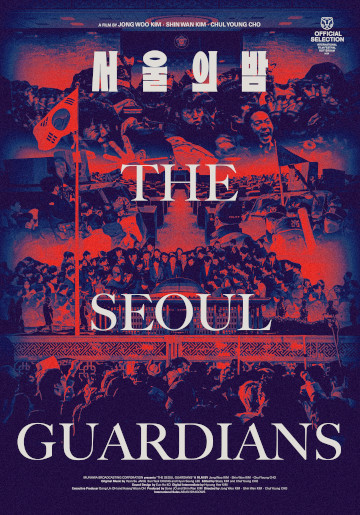
Director: Cho Chul-young, Kim Jong-woo, Shin-Wan Kim
Writer: Kim Jong-woo, Shin-Wan Kim
Year: 2026
Runtime: 70 minutes
Country: South Korea
Search database: